Close friend relationship between Jana and Ella
You Should Have LeftJana and Ella’s friendship is one of the story’s central bonds, defined by intimacy, shared history, and an ease that can turn abruptly into injury. Their relationship gives the opening its buoyant energy, but it also supplies the first major rupture: when Ella asks Jana to move out so that Ella’s new boyfriend, Martin, can move in, the friendship is forced to confront the limits of loyalty, dependence, and emotional self-control.
Identity and Foundation
Jana and Ella are presented as best friends whose closeness predates the immediate crisis. The story does not provide a childhood history for either woman; instead, it deliberately treats their established friendship as a relationship already carrying its own unexplained past. This omission matters because the bond is not built through conventional backstory. Its force appears in behavior: shared movement, familiar provocation, accumulated knowledge, and the expectation that each woman knows how the other will respond.
Their first major image together is both joyful and ominous. Jana and Ella ride a tandem bicycle along a country road in bright sunshine, with the stalks swaying and cheerful music accompanying them. Ella steers while Jana spreads her arms and blinks happily into the sun. The bicycle then strikes a rock, leaves the road, and overturns amid cries of pain before the music breaks off. The scene establishes the friendship as a form of shared momentum: the women move on one machine, but control is unevenly distributed, and their exhilaration can become a fall without warning.
The Apartment Conflict
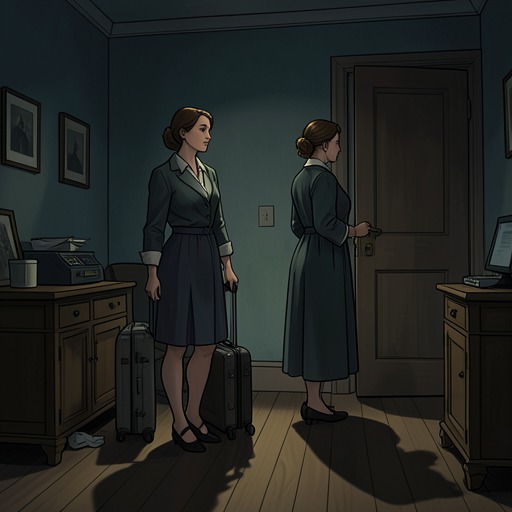
The decisive strain on the friendship occurs when Ella tells Jana to move out of the apartment where Jana had been living. Ella wants her new boyfriend Martin to move in; Martin is also Jana’s former boyfriend, and their earlier relationship ended because he was a senior tax official. Jana’s objection to Martin’s profession had been expressed with characteristic bluntness, but the new arrangement transforms an old romantic choice into a present domestic displacement. Ella is not simply asking a friend to change rooms. She is reorganizing the space of their friendship around a new relationship and making Jana absorb the cost.
Jana’s response violates the expectation built around her character. She is known for impulsiveness and for a previous fit of rage in which she insulted a gym teacher with extravagant precision. Everyone expects another eruption when she is expelled, however politely, from her best friend’s home. Instead, Jana remains calm. Ella finds this composure provocative, as though Jana’s refusal to perform the anticipated anger makes the situation harder to control. Ella insists that Jana had not wanted to live there anymore, while Jana challenges the assumption behind that claim. The exchange exposes a painful asymmetry: Ella frames the move as something Jana already desired, whereas Jana recognizes it as a decision being imposed on her.
Martin’s arrival intensifies the humiliation. He enters wearing a suit and carrying a briefcase, a conspicuous emblem of the official identity that had once made him unsuitable for Jana and now makes him acceptable to Ella. Ella, unable to direct her rage, begins shouting at him under a pretext. Jana stands there without smiling, then sadly. Her restraint is therefore not triumph over anger. It is the visible mark of a friendship whose familiar comic rhythm has failed: the expected outburst does not come, and what remains is grief.
Separation and Diverging Lives
The story organizes the first act around the consequences of this separation. Jana moves out of Ella’s apartment and has to manage on her own, while Ella lives with a man for the first time in her life. The friendship consequently changes from shared domesticity to a relation conducted across separate spaces. Jana’s new apartment becomes a setting in which Ella can still arrive suddenly, but no longer as a cohabiting companion. When Ella storms in and Jana looks up from her laptop, their contact already carries the pressure of an interruption rather than the ease of ordinary common life.
The contrast between the women’s new circumstances is sharpened by the parallel treatment of Martin. After the quarrel, Martin goes to his office dissatisfied with the identity he has become. Looking at colleagues, he recognizes in them what other people see in him: tax officials. School photographs show him before that transformation, while university images show the change beginning through his tie, seriousness, and devotion to crossword puzzles. He loosens his tie, feels insecure, and tightens it again. Then, after seeing a casually dressed pop singer in a magazine, he orders a tax audit of the singer and deliberately loosens his tie. Martin’s small act of bureaucratic retaliation confirms the world Jana had rejected, while Ella’s choice has brought that world into the space once occupied by the friendship.
Jana’s movement through the village also places the friendship inside a broader pattern of precarious dislocation. She drives down a narrow road of hairpin bends with panic, aware of her clumsiness, slow reflexes, and fear of the car as a fuel-filled capsule that can turn ordinary life into catastrophe. Thirty minutes later she reaches the village, where there is one street and one shop, Gruntner’s General Store, opposite the church. The journey ends in a sparse, cowering settlement rather than a reassuring destination. The same narrative logic that turns a shared bicycle ride into a crash now turns ordinary travel and shopping into exposure, making separation from Ella part of a larger loss of familiar coordinates.
Conflict, Loyalty, and Failed Return
The friendship does not disappear when the apartment is divided. Its remnants continue through accusation, irritation, and attempts at contact. Ella’s distress later appears in a telephone call that ends with her switching off the speakerphone, braking, pulling over, and turning around. The repeated warning to get away gives her reaction a panicked, almost compulsive force. Yet the warning does not produce a clean rescue or stable reunion. It becomes another sign that the women’s connection is being drawn into a crisis neither can master.
Their relationship also remains present in the story’s recurring attention to interpretation. Jana repeatedly asks who David is, but the question is surrounded by uncertainty about what any answer would prove. The possibility that he might be connected to people from the previous movie does not resolve the underlying issue. What matters is not only identifying a rival or assigning blame, but confronting the instability of the narrative itself: familiar characters and expected genres no longer guarantee a familiar reality. The friendship is caught in the same uncertainty. Its participants know one another well enough to anticipate reactions, yet not well enough to prevent betrayal, displacement, or fear.
The domestic arguments elsewhere in the story provide a useful contrast. The unnamed narrator and Susanna quarrel over one another’s strange behavior while Esther speaks beside them, and the child’s confused account of a preschool incident briefly gives the adults a shared task of reassurance. Jana and Ella’s bond is less protected by such a family structure. When their conflict erupts, the scene is not softened by a child’s needs; instead, the apartment itself becomes the contested object, and Martin’s entrance turns friendship into a triangular arrangement involving former lovers and a new household.
Narrative Significance
Jana and Ella’s friendship is crucial because it carries the story from comedy into estrangement without abandoning the traces of comedy that made the relationship compelling. The opening tandem bicycle promises coordinated freedom, cheerful music, and a shared direction, then abruptly replaces them with collision and pain. The apartment dispute repeats that pattern in social form: a relationship that once made movement easy becomes a structure in which one person steers and the other is forced off the route.
The story’s three-act plan makes the friendship’s reconfiguration an organizing principle. The first act follows Jana after she leaves Ella’s apartment, while Ella begins living with Martin. This is not merely background for later events. It establishes a human-scale crisis of belonging before the mountain setting develops its more disturbing spatial and perceptual threats. As the surroundings become a trap and familiar appearances cease to be reliable, the earlier friendship supplies the emotional measure of what has already been lost.
By the time people’s faces and the things they have seen acquire an ominous significance, Jana and Ella’s bond has become part of the story’s larger inquiry into unseen pressures. Their friendship once depended on shared presence and mutual expectation; after the move, those same forms of knowledge become sources of provocation and disappointment. It therefore functions neither as uncomplicated refuge nor as simple victim of circumstance. It is the first relationship through which the narrative shows that closeness can provide momentum, shelter, and recognition while also making separation feel like expulsion.